

BLOG - FINANCIA
Gold Price Dynamics (USD): 10-Year Performance, 2025 Surge and 2026 Outlook
This article analyzes the evolution of gold prices in US dollars over the past decade, with a focus on the exceptional rally in 2025 and outlook for 2026. It examines key macroeconomic drivers, investment flows, and the strategic role of gold in portfolio management and diversification.
PORTFOLIO MANAGEMENT
Mathéo Bockel
1/17/20263 min read
Gold Price Evolution Over the Last 10 Years (2015–2024)
Over the past decade, gold prices denominated in US dollars (USD) have experienced a structurally bullish trend, driven by macroeconomic uncertainty, declining real interest rates, and a renewed demand for safe-haven assets.
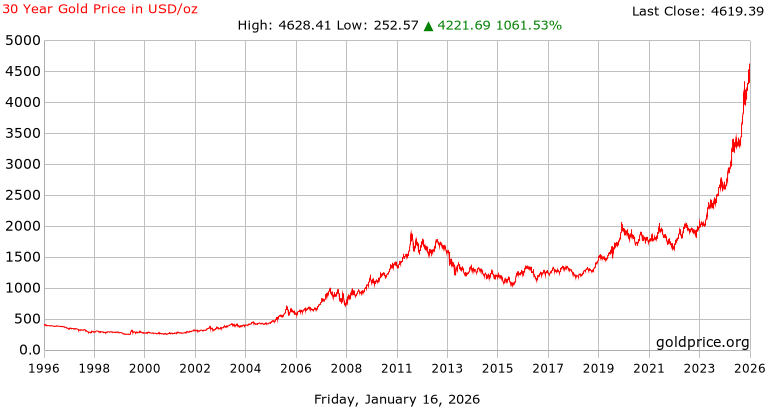
In 2015, gold reached a cyclical low near $1,060 per troy ounce, following the post-2011 correction triggered by tightening monetary conditions in the United States. From that point onward, gold entered a sustained upward cycle.
The first major acceleration occurred in 2020, during the COVID-19 financial shock. Amid unprecedented monetary stimulus, collapsing real yields, and heightened systemic risk, gold reached an all-time high of approximately $2,067/oz in August 2020. This move confirmed gold’s role as a hedge against financial instability and aggressive monetary expansion.
Between 2021 and 2023, gold consolidated but remained resilient despite rising nominal interest rates. Key supporting factors included:
Persistently negative or near-zero real rates
Elevated global inflation
Strong central bank demand, particularly from emerging economies
Increasing geopolitical tensions
In 2024, gold entered a new breakout phase. Prices surged above $2,600/oz, with the World Gold Council reporting a record number of new highs throughout the year. Central banks purchased over 1,000 tonnes of gold for the third consecutive year, reinforcing gold’s strategic status in official reserves. By the end of 2024, gold had appreciated by more than 150% compared to its 2015 low, marking one of the strongest decade-long performances among major asset classes.
Exceptional Performance in 2025
The year 2025 marked a historic turning point for gold markets. Starting the year near $2,640/oz, gold entered a powerful rally that accelerated rapidly in the first half of the year.
By April 2025, prices had already exceeded $3,200/oz, supported by:
Escalating geopolitical conflicts
Heightened sovereign debt concerns
Growing expectations of monetary easing by the Federal Reserve
During the second half of the year, gold entered a parabolic phase. In October 2025, gold surpassed $4,300/oz, before reaching a new historical peak near $4,560/oz in December 2025. Even after a modest technical correction, gold ended the year around $4,400/oz, representing an annual gain of approximately +40%.
Investment flows played a critical role:
Gold-backed ETFs experienced sustained inflows
Central banks continued aggressive accumulation
Institutional investors increased strategic allocations amid declining confidence in fiat currencies
The magnitude of the 2025 rally places it among the most significant gold bull markets since the late 1970s.
Gold Price Forecasts for 2026
Looking ahead to 2026, most financial institutions expect gold prices to remain elevated, though with potentially lower volatility than in 2025.
Major forecasts include:
Goldman Sachs: Target around $4,900/oz, with upside potential if portfolio reallocation toward real assets accelerates.
Bank of America: Average price forecast of approximately $4,500/oz for 2026.
UBS: Bullish scenario targeting $5,000/oz, potentially as early as the first half of 2026.
World Gold Council scenario analysis suggests:
Stable to moderately higher prices in baseline scenarios
Further upside (+15–30%) in recessionary or crisis environments
Downside only in the event of strong global growth combined with sharply rising real rates
A key structural support remains central bank behavior. Surveys indicate that over 90% of central banks plan to maintain or increase gold reserves in 2026, driven by diversification away from the US dollar and rising geopolitical fragmentation.
Gold’s Role in Portfolio Management
From a portfolio construction perspective, gold remains a critical strategic asset.
Diversification and Correlation
Gold historically exhibits:
Low or negative correlation with equities
Negative correlation with real interest rates
Inverse relationship with the US dollar over long horizons
This makes gold particularly valuable when stocks and bonds fall simultaneously, as observed during recent inflationary shocks.
Inflation and Monetary Risk Hedge
While gold is not a perfect short-term inflation hedge, it performs well in environments of:
High inflation uncertainty
Monetary credibility erosion
Currency debasement risks
Absence of Credit Risk
Gold carries no counterparty or default risk, unlike bonds or fiat currencies. This feature explains its continued relevance in extreme financial stress scenarios.
Strategic Allocation
Most institutional frameworks recommend an allocation of 5–10% to gold within diversified portfolios, depending on risk tolerance and macroeconomic outlook. In recent years, many asset managers have increased gold exposure due to:
Rising geopolitical risk
Structural inflation pressures
Reduced diversification benefits of traditional asset mixes
Strategic Conclusion for Investors in 2026
As we approach 2026, gold has firmly re-established itself as a core strategic asset rather than a tactical hedge. The last decade demonstrates that gold benefits structurally from:
Declining confidence in fiat currencies
Elevated geopolitical risk
Long-term monetary expansion
While the extraordinary gains of 2024–2025 may not repeat at the same pace, gold’s risk-mitigation role remains intact. Most credible forecasts point toward price stabilization or moderate appreciation rather than a structural reversal.
For investors, the key challenge is not whether to hold gold, but how much. Maintaining a disciplined allocation allows portfolios to remain resilient across a wide range of macroeconomic scenarios. In an era marked by regime shifts in inflation, geopolitics, and monetary policy, gold continues to act as a strategic anchor within long-term portfolio management.
Sources :
World Gold Council, Bloomberg, Reuters, Bank of America Research, Goldman Sachs Global Investment Research, UBS Global Wealth Management, IMF data, historical gold price databases.
GET IN TOUCH
Have a question, a partnership idea, or want to share your thoughts about finance?
At Financia, we value meaningful connections with our readers and collaborators.
Reach out and let’s start a conversation, your insights could inspire our next article.