

BLOG - FINANCIA
Oil Is No Longer a Commodity: Markets Begin Pricing Geopolitics Again
As tensions rise between the U.S. and Iran and sanctions dynamics shift around Venezuela, oil markets in mid-February 2026 are already transitioning toward a new regime where geopolitical risk, not fundamentals, drives pricing and capital allocation.
FINANCIAL MARKETS
Mathéo Bockel
2/15/20263 min read
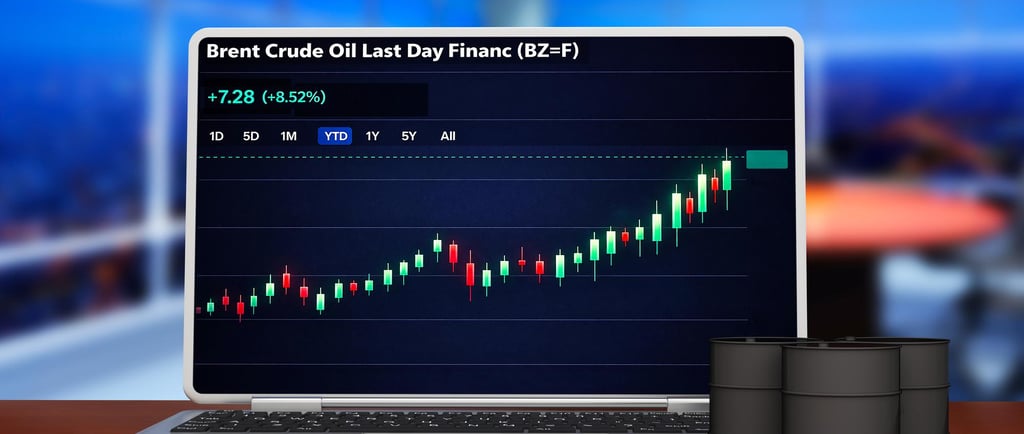
By mid-February 2026, global oil markets are already exhibiting the early signs of a structural regime shift, well before the full escalation observed later in March. At this stage, the market is not yet in crisis, but it is clearly transitioning away from a traditional supply-demand equilibrium toward a system increasingly shaped by geopolitical uncertainty, sanctions policy, and strategic positioning by major powers. Data from the International Energy Agency confirms that global oil supply had already been disrupted at the start of the year, with production falling by approximately 1.2 million barrels per day in January due to a combination of weather shocks, export constraints, and geopolitical frictions affecting key producers including Venezuela and Russia . At the same time, demand remained resilient, particularly from non-OECD economies such as China, creating a tightening market backdrop in which even minor geopolitical signals could trigger outsized price reactions.
This growing sensitivity to geopolitical developments is clearly visible in price dynamics throughout early February. Oil prices fluctuated significantly within a relatively narrow range, reacting less to fundamental data and more to expectations surrounding U.S.–Iran negotiations. For instance, on February 12, prices dropped nearly 3% following signs of potential diplomatic progress, only to rebound sharply days later as fears of disruption re-emerged, pushing Brent crude toward $71–72 per barrel, its highest level in six months . This pattern reveals a critical shift: markets are no longer pricing current supply conditions, but rather forward-looking geopolitical scenarios, effectively embedding probability-weighted conflict outcomes into asset prices.
At the same time, U.S. policy toward Venezuela further illustrates the increasing politicization of oil markets. On February 13, Washington expanded sanctions waivers to allow international companies to operate in Venezuela’s oil sector and facilitate new export agreements . This move was not driven by market efficiency considerations, but by a strategic objective: preemptively securing alternative supply sources in anticipation of potential disruptions in the Middle East. In parallel, Venezuela began reorienting its oil exports away from Asia and toward Western markets, signaling a rapid reconfiguration of global trade flows even before any actual supply shock materialized . This highlights a key structural development: oil supply is increasingly shaped by political alignment rather than comparative advantage.
Simultaneously, sanctions pressure on Iran intensified throughout February, targeting individuals and entities involved in its petroleum trade and reinforcing constraints on its official export channels. However, rather than removing Iranian oil from global markets, these measures contributed to the expansion of opaque and alternative trading mechanisms. The result is the gradual emergence of a dual market structure: an official, regulated system coexisting with a less transparent network of discounted flows. While this phenomenon becomes more visible later, its foundations are already clearly present in mid-February. For financial markets, this introduces a fundamental distortion: benchmark prices such as Brent increasingly fail to capture the full spectrum of global oil transactions, weakening their role as reliable indicators.
The implications for financial markets at this stage are subtle but profound. First, a geopolitical risk premium begins to embed itself structurally into oil prices. Unlike past cycles where such premiums were episodic, the persistence of geopolitical uncertainty, combined with the lack of a clear resolution to U.S.–Iran tensions, suggests that volatility will become a permanent feature rather than a temporary deviation. Second, market behavior becomes increasingly nonlinear. Small pieces of information, diplomatic statements, sanctions updates, or military positioning, generate disproportionately large price movements, reflecting heightened sensitivity and reduced predictability. Third, cross-asset correlations begin to shift. Energy prices start influencing not only commodity markets but also inflation expectations, bond yields, and equity sector rotation, as investors anticipate the broader macroeconomic consequences of sustained energy volatility.
From an investment perspective, mid-February 2026 represents the inflection point at which geopolitics re-enters financial pricing models as a first-order variable. For equity investors, this implies a gradual rotation toward energy producers and commodity-linked sectors, even before the full realization of the crisis. For credit markets, it introduces upward pressure on inflation expectations and yields, particularly affecting long-duration assets and leveraged structures. For private equity, the implications are even more structural: deal underwriting must increasingly incorporate energy price volatility, geopolitical exposure, and supply chain resilience as core variables rather than secondary risks.
Ultimately, what is observable on February 15, 2026 is not yet a crisis, but the precondition of a new financial regime. Markets are beginning to price uncertainty not as a tail risk, but as a central scenario. Oil, in this context, ceases to function as a purely economic commodity and instead becomes a forward-looking indicator of geopolitical instability. The events that unfold later in March will only accelerate this trend—but the shift itself is already clearly underway.
GET IN TOUCH
Have a question, a partnership idea, or want to share your thoughts about finance?
At Financia, we value meaningful connections with our readers and collaborators.
Reach out and let’s start a conversation, your insights could inspire our next article.